
You’ve probably seen the term “domain authority” thrown around in SEO conversations. Maybe you checked your score and felt confused about what it actually means — or what to do about it.
Here’s the honest answer: domain authority matters, but not in the way most people think. It’s not a Google ranking factor. It’s a third-party metric. But it’s still a useful signal for understanding how your website stacks up — and where you need to improve.
This guide covers what domain authority actually is, why it matters for your SEO, and the concrete steps you can take to grow it over time.
What Is Domain Authority?
Domain Authority (DA) is a score developed by Moz. It predicts how likely a website is to rank in search engine results. The score runs from 1 to 100. Higher is better.
Other SEO tools have their own versions:
- Domain Rating (DR) — Ahrefs
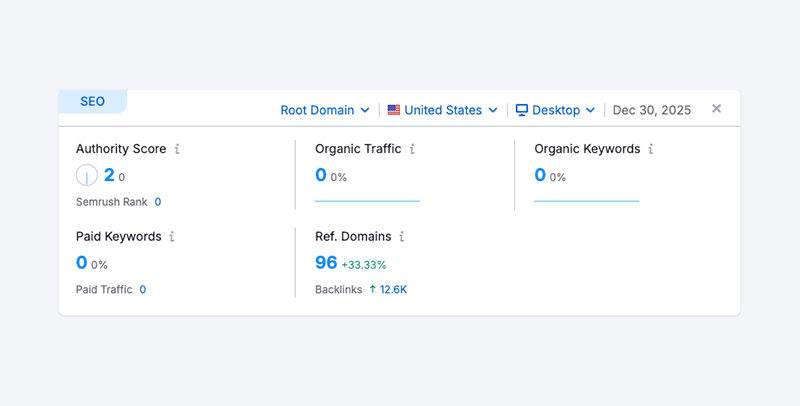
- Authority Score — Semrush
- Trust Flow / Citation Flow — Majestic
The names differ, but the idea is the same. Each score estimates a website’s overall strength based largely on its backlink profile — how many websites link to it and how trustworthy those websites are.
A brand new website starts near 1. Established sites like Wikipedia or the BBC score in the 90s. Most healthy, growing websites sit somewhere between 20 and 60.
Does Domain Authority Affect Google Rankings?
Not directly. Google has confirmed it does not use Moz’s DA score as a ranking signal.
But here’s why it still matters:
A high DA typically reflects the same things Google does value — quality backlinks, trustworthy content, and a well-established web presence. When your DA improves, it usually means the underlying factors that Google cares about are also improving.
Think of DA as a dashboard indicator, not the engine itself. It tells you how your site is performing relative to others. Tracking it over time helps you understand whether your SEO efforts are moving in the right direction.
What Actually Determines Your Domain Authority Score?
Before trying to improve your DA, you need to understand what drives it.
The biggest factors:
- Number of referring domains — how many unique websites link to you
- Quality of those linking sites — links from high-authority sites carry more weight
- Link relevance — links from websites in your niche matter more than random links
- Internal link structure — how well your pages link to each other
- Content quality — sites with strong, original content attract more natural links
- Technical SEO health — crawlability, site speed, and indexability affect how well your site is evaluated
One strong backlink from a reputable, relevant website is worth more than dozens of links from low-quality sources. Quality always outweighs quantity when it comes to DA growth.
How Long Does It Take to Increase Domain Authority?
Let’s set realistic expectations upfront. Domain authority does not increase fast — not legitimately, anyway.
Most websites see meaningful DA growth over months, not weeks. For newer websites, moving from DA 1 to DA 20 can take six to twelve months of consistent effort. Moving from DA 20 to DA 40 can take another year or more.
Why so slow?
- Building quality backlinks takes time and relationship-building
- Google and Moz crawl the web on a schedule — new links don’t reflect instantly
- DA is a relative score — as your score grows, so does everyone else’s
Anyone promising to “increase your domain authority fast” in days or weeks is either misleading you or using tactics that could get your site penalized. Steady, legitimate growth is the only kind that lasts.
Step 1: Build Quality Backlinks Consistently
Backlinks are the single biggest driver of domain authority. Not just any backlinks — quality ones from relevant, trustworthy websites.
Guest Posting
Write original articles for other websites in your niche. In return, you earn an editorial backlink pointing to your site. Guest posting on well-established sites with real audiences is one of the most reliable ways to build quality backlinks steadily over time.
Broken Link Building
Find broken links on relevant websites and suggest your content as a replacement. Tools like Ahrefs or Check My Links help you identify these opportunities. Website owners are usually happy to fix broken links — you’re solving a problem for them.
Resource Page Link Building
Many websites maintain resource pages listing helpful tools, guides, and articles in a niche. Getting your content listed on relevant resource pages earns strong, contextual backlinks.
Digital PR
Create newsworthy content — original research, data studies, expert commentary — that journalists and bloggers want to cite. A single piece of high-value data can earn dozens of backlinks from reputable websites.
If you’d like to learn more about the link building, then check our pillar guide: Link building in SEO – a complete guide.
Step 2: Create Content Worth Linking To
You can’t build great backlinks without great content. The two go together.
Content that earns links naturally tends to be:
- Original research or data — statistics others want to cite
- Comprehensive guides — deep, well-organized resources on a topic
- Tools and calculators — interactive content that people bookmark and share
- Expert opinion pieces — unique perspectives backed by experience
- Infographics and visuals — shareable formats that attract links from other articles
Ask yourself this before publishing: would another website genuinely link to this? If the answer is no, it’s worth improving before you hit publish.
Step 3: Fix Your Technical SEO
Technical issues prevent search engines from properly crawling and indexing your site. This directly limits how your site gets evaluated — which affects your authority score.
Run a Technical Audit
Use tools like Screaming Frog, Ahrefs, or Google Search Console to find:
- Broken links and 404 errors
- Crawl blocks in your robots.txt
- Missing or duplicate meta tags
- Pages not included in your sitemap
Improve Site Speed
Slow websites frustrate users and get crawled less efficiently. Test your speed with Google PageSpeed Insights and address the top issues — compress images, enable browser caching, and reduce server response time.
Make Sure Your Site Is Mobile-Friendly
Google indexes the mobile version of your site first. If it doesn’t work well on phones, your rankings — and by extension your authority score — will suffer. Use Google’s Mobile-Friendly Test to check.
Step 4: Remove or Disavow Toxic Backlinks
Not all backlinks help you. Some actively drag your score down.
Low-quality links come from:
- Link farms and private blog networks (PBNs)
- Irrelevant, spammy directories
- Sites with no real traffic or content
- Websites that have been penalized by Google
Regularly audit your backlink profile using Ahrefs, Semrush, or Google Search Console. If you find links from clearly spammy or irrelevant sources, you have two options:
- Contact the linking site and request removal
- Disavow the link using Google’s Disavow Tool, telling Google to ignore it
Cleaning up a toxic backlink profile can produce a noticeable improvement in your DA score — sometimes quickly.
Step 5: Strengthen Your Internal Linking
Internal links pass authority between your own pages. A strong internal linking structure helps distribute the authority from your strongest pages to ones that need a boost.
Best practices for internal linking:
- Link from high-traffic, high-authority pages to newer or weaker ones
- Use descriptive anchor text that tells readers and search engines what the linked page is about
- Audit old posts regularly and add links to newer relevant content
- Make sure every important page on your site is reachable within a few clicks from the homepage
This is one of the most overlooked DA-building strategies. It costs nothing and can significantly improve how your site’s overall authority is distributed.
Step 6: Build Your Brand Online
Domain authority grows faster when your website is a recognized brand — not just a collection of pages.
Ways to build online brand signals:
- Be consistent on social media — regular activity signals an active, legitimate site
- Get listed in reputable industry directories and databases
- Earn mentions (even unlinked ones) on respected websites
- Publish content regularly to show your site is maintained and growing
- Build an email list — it creates a direct audience that drives repeat traffic
Brand strength isn’t a direct DA signal, but it drives the behaviors — more traffic, more shares, more natural links — that do push your score up over time.
Step 7: Increase the Number of Referring Domains
One thing many site owners miss: it’s not just about getting more backlinks. It’s about getting backlinks from more unique domains.
Ten links from one website count for far less than ten links from ten different websites. Search engines treat each new referring domain as a fresh vote of confidence.
How to diversify your referring domains:
- Target a variety of sites in your outreach — not the same few repeatedly
- Contribute to different publications, podcasts, and communities in your niche
- Repurpose content across formats to earn links from different types of sites
- Collaborate with other creators or businesses on joint content
Track your referring domain count in Ahrefs or Semrush. A steady month-over-month increase is one of the clearest signals that your DA is heading in the right direction.
What Not to Do When Trying to Improve Domain Authority
Some tactics seem like shortcuts but create serious long-term problems.
Avoid these:
- Buying backlinks — Google penalizes this, and it can tank your rankings overnight
- Using private blog networks (PBNs) — these carry heavy penalties when discovered
- Submitting to low-quality link directories — these add clutter, not authority
- Obsessing over DA to the exclusion of real SEO — DA is a proxy metric; ranking performance is what actually matters
The goal is to build a website that genuinely deserves a high authority score — one with useful content, real backlinks, and a trustworthy presence. The score follows naturally from that.
How to Track Your Domain Authority Progress
Check your DA monthly — not daily. Scores shift slowly, and checking too often leads to unnecessary anxiety over small fluctuations.
Tools to use:
- Moz Link Explorer — the original DA score
- Ahrefs — Domain Rating (DR) and referring domains overview
- Semrush — Authority Score and backlink audit
- Google Search Console — for organic traffic and indexing health
Alongside DA, track the metrics that actually drive rankings:
- Organic traffic growth in Google Search Console
- Number of referring domains (aim for steady monthly growth)
- Keyword rankings for your target pages
- Backlink quality and relevance
These numbers tell the fuller story. A rising DA alongside growing traffic confirms your strategy is working.
Final Thoughts
Domain authority is a useful compass, not a destination. Chasing the number without building the substance behind it gets you nowhere.
The websites with the highest authority scores share a common pattern. They publish content people genuinely find useful. They earn links from websites that trust them. They’re technically sound and consistently maintained.
That’s not a secret formula. It’s just good SEO, done consistently over time.
Focus on the inputs — quality content, real backlinks, strong technical foundations — and the authority score will follow. Start with the steps in this guide, work through them one by one, and give your efforts time to compound.
There are no genuine shortcuts. But there is a clear path — and it works.
FAQs
What is a good domain authority score?
It depends on your niche and competition level. A DA of 20–30 is reasonable for a newer site. Scores of 40–60 are considered solid. Above 60 is strong. What matters more than the raw number is whether your score is higher than your direct competitors.
How often does domain authority update?
Moz updates DA scores roughly every month. Changes can be subtle — don’t expect dramatic jumps. Track it monthly rather than weekly to get a clearer picture of trends over time.
Can domain authority decrease?
Yes. If competitors grow their backlinks faster than you, your relative score can drop. Losing high-quality backlinks, accumulating toxic links, or having technical issues can also cause a decline.
Is domain authority the same as domain rating?
No. Domain Authority (DA) is Moz’s metric. Domain Rating (DR) is Ahrefs’ equivalent. Both measure backlink strength but use different methodologies. It’s common to track both for a fuller picture.
Does social media affect domain authority?
Not directly. Social media links are typically nofollow and don’t pass authority. But social activity drives traffic, brand visibility, and natural backlinks — all of which indirectly support DA growth over time.
How many backlinks do I need to increase domain authority?
There’s no fixed number. The quality and relevance of backlinks matter more than quantity. Ten strong, relevant backlinks from reputable sites will move your DA more than a hundred low-quality ones.
Can I increase domain authority without building backlinks?
Backlinks are the primary driver of DA. You can improve related signals — content quality, technical SEO, internal linking — but without earning external backlinks, your DA will have a ceiling. Backlink building is essential.