
You’ve probably heard the terms dofollow and nofollow in SEO conversations. But what do they actually mean?
More importantly — do they still matter today, or are they just outdated jargon?
Whether you’re a blogger, a small business owner, or just getting started with SEO, this guide breaks it all down in plain language. No fluff, no confusion.
What Is a Dofollow Link?
A dofollow link is the default state of any hyperlink on the web. When you link to another page without any special tag, it’s automatically a dofollow link.
These links tell search engines: “I trust this page. Pass some of my site’s authority to it.”
In SEO, this transfer of authority is called link equity — sometimes called link juice. When a reputable site links to yours with a dofollow link, Google takes notice. It can improve your search rankings.
What does a dofollow link look like in code?
A standard HTML link is dofollow by default. No extra tag is needed:
<a href=”https://example.com”>Visit Example</a>
Simple and clean. If no rel attribute appears, the link passes full equity.
| KEY IDEA
Dofollow is the default. A regular HTML link with no extra attribute is always dofollow. You don’t have to do anything special to create one. |
What Is a Nofollow Link?
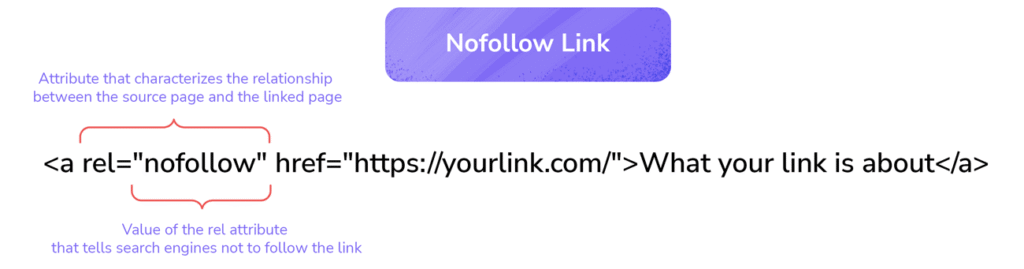
A nofollow link carries a special tag that tells search engines not to pass link equity to the linked page.
Google introduced the nofollow attribute in 2005. The goal was to fight comment spam — people were flooding blog comments with links just to manipulate search rankings.
What does a nofollow link look like?
<a href=”https://example.com” rel=”nofollow”>Visit Example</a>
See the rel=”nofollow” part? That small addition tells search engines to step back and not pass authority.
Nofollow links are commonly used in these situations:
- Blog comments and forum posts
- Paid or sponsored content
- User-generated content on platforms you don’t fully control
- Links you’re not willing to vouch for
The Newer Link Attributes: Sponsored and UGC
In 2019, Google expanded the link attribute system. Two new tags joined the family alongside nofollow.
rel=”sponsored”
Use this for any link that’s part of a paid deal — ads, affiliate links, or sponsored posts. It clearly signals to Google that money was involved.
rel=”ugc”
UGC stands for User Generated Content. Use this for links in comments, forums, or reviews that your users submitted. It helps Google understand the link’s context.
| QUICK TIP
You can combine attributes: rel=”nofollow sponsored” or rel=”ugc nofollow” — both are valid. Use what fits the context of the link. |
Google treats all three — nofollow, sponsored, and ugc — similarly. None of them reliably pass link equity. But they do help search engines understand your site better.
Dofollow vs Nofollow: Side-by-Side
Here’s a clear comparison so you can see exactly how these link types differ:
| Factor | Dofollow Links | Nofollow Links |
| Passes link equity? | Yes | No (officially) |
| Affects rankings? | Directly, yes | Indirectly possible |
| Used for? | Editorial, trusted links | Ads, sponsored, UGC |
| Default state? | Yes — every link is dofollow by default | Must be added manually |
| Google crawls them? | Yes | Yes, but may ignore |
| Anchor text counted? | Yes, fully | Less weight |
| Risk of penalty? | Yes, if links are manipulated | Low — safer for paid links |
| Value today? | High for direct SEO impact | Still valuable for traffic |
Does a Nofollow Link Have Any SEO Value?
This is the big question — and the answer might surprise you.
Google updated its stance on nofollow links in 2019. It shifted from treating nofollow as a strict rule to treating it as a hint. That means Google might still crawl a nofollow link and factor it into its decisions — it just doesn’t have to.
What nofollow links actually do today
- They signal you’re not personally vouching for the linked page
- They reduce the risk of a penalty for paid links
- Google may still crawl and consider the page
- They can send real visitors to your site through referral traffic
- They contribute to a natural-looking link profile
Why referral traffic from nofollow links still matters
Even without link equity, a nofollow link on a high-traffic site can bring thousands of visitors. More visitors often means more engagement, more shares, and sometimes more natural dofollow links down the line.
Think of a nofollow link as an informal recommendation. It still gets people through the door.
When Should You Use Nofollow?
You don’t need to nofollow every external link. But some situations clearly call for it.
Use nofollow when:
- You’re linking to a paid or sponsored partner
- You’re showing links from user comments or reviews
- You’re using affiliate links that earn you commission
- You’re linking to a page you don’t fully trust
- A link comes from a widget or embedded content
Keep it dofollow when:
- You’re linking to a source you genuinely recommend
- You’re citing research, data, or reference material
- You’re linking to a partner or resource you endorse
- The link is editorial and adds real value to the reader
| COMMON MISTAKE
Some site owners nofollow all outbound links thinking it saves their link equity. It doesn’t. Google doesn’t reward hoarding authority. Link naturally to quality sources — that’s what Google actually wants. |
Do Nofollow Links Help You Rank?
Directly? Not reliably. Indirectly? More than most people think.
Here’s how a nofollow link can still push your SEO forward:
- Brand visibility — people see your name on authoritative sites
- Referral traffic — visitors arrive already interested in what you offer
- Natural link building — some visitors may later link back with a dofollow link
- Trust signals — Google sees your brand mentioned across the web
- Anchor text diversity — a healthy mix of link types looks organic to Google
A link profile made entirely of dofollow links can actually look suspicious. A natural mix of both signals genuine, organic growth to search engines.
How to Check If a Link Is Dofollow or Nofollow
You don’t need a paid tool to check link types. Here are three simple ways:
Option 1: Inspect the page source
- Right-click any link on a webpage
- Select “Inspect” or “View Page Source”
- Look for rel=”nofollow” inside the link’s HTML
- No rel tag? It’s dofollow by default
Option 2: Use a browser extension
Tools like the NoFollow Chrome extension highlight nofollow links with a coloured border on any page. It’s a quick visual check without touching any code.
Option 3: Use SEO tools
Platforms like Ahrefs, Semrush, and Moz show link types inside their backlink reports. If you manage a site seriously, these tools are worth the investment.
The Bottom Line
Yes — dofollow vs nofollow links still matter. But not in the rigid way they used to.
Dofollow links remain the gold standard for direct SEO impact. If you’re building backlinks, your main goal should be earning dofollow links from authoritative, relevant websites.
But nofollow links are far from worthless. They drive traffic, build brand awareness, and help shape a link profile that search engines trust.
The smartest link-building strategy doesn’t obsess over link type. It focuses on earning links from great sites and letting the attributes take care of themselves.
Chase quality. The rest follows.
If you’d like to learn about the link building in SEO in detail, check our detailed guide: What is link building in SEO – a complete guide.
FAQs
Q1. What is the main difference between dofollow and nofollow links?
A dofollow link passes link equity from one page to another, which can influence search rankings. A nofollow link includes a tag that tells search engines not to pass that value. Dofollow links have direct SEO impact. Nofollow links officially don’t — but they can still drive traffic.
Q2. Are nofollow links completely useless for SEO?
No. Nofollow links still bring referral traffic, build brand visibility, and contribute to a natural-looking link profile. Since 2019, Google treats nofollow as a hint rather than a hard rule — so it may still factor some nofollow links into its ranking signals.
Q3. Do I need to nofollow all my outgoing links?
No. Only nofollow paid, sponsored, untrusted, or user-generated links. Linking editorially to quality external sources is a good practice. Nofollowing everything looks unnatural and gives you no SEO advantage.
Q4. What happens if I use a dofollow link in a paid post?
Google treats paid dofollow links as a violation of its link spam policies. If discovered, your site could face a manual penalty. Always use rel=”sponsored” or rel=”nofollow” on paid or affiliate links to stay safe.
Q5. How do I check if a backlink to my site is dofollow or nofollow?
Use SEO tools like Ahrefs, Semrush, or Moz. They clearly label each backlink in your profile as dofollow or nofollow. You can also inspect the source code of the linking page directly in your browser for free.