
There is a moment every blogger and business owner eventually faces. The content is written, the page is optimized, the site loads cleanly — and yet the rankings sit stubbornly on page two or three, refusing to move.
In most cases, the missing piece is not better writing or faster hosting. It is authority. And the primary way websites build authority in Google’s eyes is through link building.
This guide covers everything you need to understand about link building — what it is, why it works, how Google evaluates links, which strategies deliver real results, what mistakes to avoid, and how to measure whether your efforts are actually paying off. Whether you are a blogger just starting out or a business owner trying to understand what a link building agency is actually doing on your behalf, this is the resource you need.
Table of Contents
- What Is Link Building in SEO
- Why Backlinks Matter to Google
- How Google Evaluates Link Quality
- Types of Backlinks You Should Know
- Core Link Building Strategies
- What Link Building Agencies Do
- Content Marketing for Link Building
- Digital PR Link Building
- Social Media and Link Building
- Common Link Building Mistakes
- How to Measure Your Link Building Results
- How Long Does Link Building Take
- Link Building Frequently Asked Questions
What Is Link Building in SEO
Link building is the process of earning or acquiring hyperlinks from other websites that point back to pages on your own site. These inbound links are called backlinks, and they are one of the most important ranking signals in all of search engine optimization.
When another website links to yours, it is making a statement. It is saying that your content is credible, useful, or authoritative enough to be referenced. Google interprets these signals as votes of confidence — and the more credible the site casting that vote, the more weight it carries in determining where your pages rank.
This concept is not new. Google’s original PageRank algorithm — the foundation the entire search engine was built upon — ranked web pages based on how many other pages linked to them, and how authoritative those linking pages were. That core logic has survived every major algorithm update for over two decades. Backlinks remain one of Google’s top three confirmed ranking factors alongside content relevance and user experience.
Understanding what link building is, at its core, means understanding that SEO is not just about what you say on your own pages. It is about what the rest of the web says about you.
Why Backlinks Matter to Google
Google’s fundamental challenge is credibility. Anyone can publish a page claiming to be the definitive guide on any topic. Anyone can write polished, well-formatted content. Google needed a way to verify trustworthiness that goes beyond the words on a page — and the link graph of the internet became that verification system.
Think of backlinks as professional references. If a widely respected expert in your field recommends your work, that recommendation carries genuine weight. If an unknown source with no track record recommends you, it carries almost none. The value of the recommendation is proportional to the credibility of the person giving it.
This is why authority link building focuses on quality rather than volume. A single backlink from a well-established publication in your niche can do more for your rankings than a hundred links from low-quality, unrelated directories.
Beyond individual rankings, backlinks also affect two broader metrics that shape your site’s overall SEO performance:
- Domain Authority (DA) — a metric developed by Moz that predicts how likely a domain is to rank, based largely on its backlink profile
- Domain Rating (DR) — Ahrefs’ equivalent metric, measuring the strength of a website’s backlink profile on a scale from zero to one hundred
These are not official Google metrics, but they closely correlate with ranking ability and are widely used by SEO professionals and link building agencies to evaluate site strength.
How Google Evaluates Link Quality
Not all backlinks help you. Some are neutral. Some actively damage your rankings. Google’s ability to distinguish between high-quality editorial links and manipulative link schemes has become increasingly sophisticated.
When evaluating a backlink, Google considers several factors:
Relevance A link from a website in the same or closely related niche as yours carries far more value than a link from an unrelated site. A link to your health blog from a medical publication is meaningful. A link from an unrelated automotive parts directory is not — and in some cases, raises a red flag.
Authority of the Linking Domain Links from websites with strong, established authority pass more ranking power than links from new or low-authority sites. This is often referred to as link equity or link juice — the authority that flows from one page to another through a hyperlink.
Anchor Text Anchor text is the clickable, visible text of a hyperlink. Google reads anchor text as a signal about what the linked page is about. Over-using exact-match keywords in anchor text across many backlinks looks manipulative and can trigger penalties. A natural backlink profile contains a healthy variety — branded anchors, partial match phrases, generic terms like “read more” or “this article,” and natural contextual descriptions.
Link Placement Editorial links placed within the body of a genuine article carry more weight than links placed in footers, sidebars, or comment sections. Google distinguishes between links that are naturally part of editorial content and links that have been placed purely for SEO benefit.
Dofollow vs Nofollow A dofollow link instructs Google to follow the link and pass authority to the destination page. A nofollow link contains an HTML attribute that signals Google should not pass authority. Most high-value editorial links are dofollow. A healthy backlink profile includes both, since a profile consisting entirely of dofollow links can itself appear unnatural.
Link Velocity The rate at which you acquire new backlinks matters. A sudden, unnatural spike in new links — especially from low-quality sources — can trigger algorithmic scrutiny. Sustainable link building grows a backlink profile gradually and consistently.
Types of Backlinks You Should Know
Understanding the categories of backlinks helps you evaluate what you already have and identify what to pursue.
Editorial Links These are the most valuable backlinks. They are given naturally by other writers and publishers who reference your content because it genuinely deserves to be cited. Earning editorial links consistently is the long-term goal of any serious link building strategy.
Guest Post Links Links earned by contributing an article to another website in your niche. When executed with genuine editorial quality — not thin content placed purely for the link — guest posting is one of the most scalable and reliable link acquisition methods available.
Digital PR Links Links earned by creating newsworthy content that journalists and publications cite as a source. These are covered in detail in the digital PR section below.
Resource Page Links Links from curated “resources” or “recommended reading” pages that point to useful content in a given niche. These are earned through targeted outreach to site owners who maintain these pages.
Broken Link Building Links acquired by identifying broken links on other sites and offering your own relevant content as a replacement. The site owner benefits by fixing a broken user experience; you benefit by earning a backlink.
Niche Directory Links Links from curated, topic-specific directories that are genuinely useful to readers. Unlike low-quality general directories, reputable niche directories carry editorial standards and provide real referral traffic.
Toxic Links Links from private blog networks, link farms, paid link schemes without disclosure, and irrelevant low-quality sites. These do not help rankings and can attract manual or algorithmic penalties from Google. Identifying and disavowing toxic links is an important maintenance task for any established domain.
Core Link Building Strategies
A sustainable SEO link building strategy does not rely on a single tactic. It combines multiple approaches depending on your niche, content assets, budget, and competitive landscape.
Guest Posting
Guest posting remains the most widely used and scalable link building tactic in practice. It involves writing an article for another website in exchange for an editorial link back to your content. The key to doing this correctly is quality — both in the content you produce and in the sites you target.
The best guest posting placements are on sites with real readership, genuine editorial standards, and relevant audiences. Sites that exist solely to publish guest posts for links — often called “link farms” or “PBNs” — offer no long-term value and carry meaningful risk.
For businesses and bloggers who want to scale this process, link building agencies maintain vetted inventories of publisher sites and handle outreach, writing, and placement end to end.
For a full walkthrough of how to pitch and place guest posts, see our dedicated guide: How to Get Started with Guest Posting.
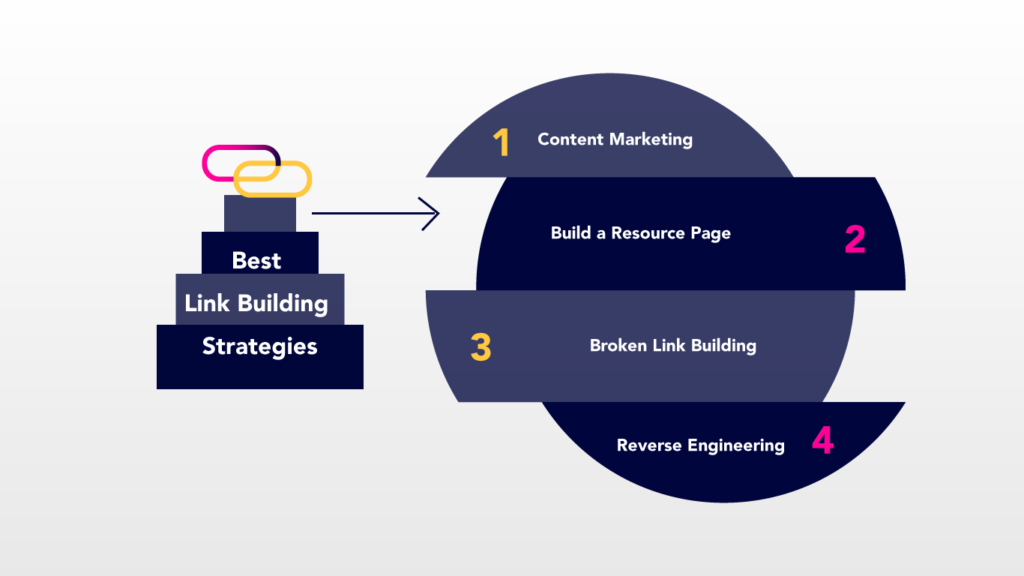
Broken Link Building
Broken link building is a three-step process. First, identify pages on authoritative sites in your niche that contain links pointing to pages that no longer exist. Second, create or identify content on your own site that would serve as a relevant replacement. Third, reach out to the site owner, flag the broken link, and suggest your content as a substitute.
This tactic works because you are solving a real problem for the webmaster while earning a link in return. It takes patience and requires systematic prospecting, but the links earned are clean, editorial, and contextually relevant.
For a step-by-step breakdown of this process, see our guide: Broken Link Building for Beginners.
Resource Page Link Building
Many websites in every niche maintain pages that curate useful resources, tools, and reading recommendations for their audience. Identifying these pages and reaching out with a compelling case for why your content belongs on the list is a legitimate and accepted link building tactic.
The outreach message matters significantly here. Generic “please add my link” emails get ignored. A personalized note that demonstrates you have read the page, explains why your content is relevant to their audience, and offers something of genuine value dramatically improves response rates.
Skyscraper Technique
Developed by Brian Dean, the skyscraper technique involves three steps: finding content in your niche that has earned many backlinks, creating a significantly better version of that content, and then reaching out to the sites linking to the original to let them know a superior resource exists.
When executed well, this produces high-quality editorial links at scale. The critical variable is the quality improvement — simply rewriting existing content with more words does not qualify. The improved version must be genuinely more useful, more current, more comprehensive, or more visually accessible than what it replaces.
HARO and Journalist Outreach
Help A Reporter Out (HARO) and similar platforms connect journalists with expert sources. By responding to relevant media queries with useful, credible commentary, you can earn links from major publications that would otherwise be nearly impossible to reach.
This approach works best when you have a genuine perspective or expertise to offer. Journalists are inundated with responses — vague, generic commentary gets ignored. Specific, data-backed, or experience-driven insights earn placement.
See our guide: How to Use HARO for Backlinks to learn the full process.
What Link Building Agencies Do
For businesses and content creators who do not have the time or resources to manage outreach, content creation, and publisher relationships in-house, link building agencies provide end-to-end management of the entire process.
A reputable link building SEO agency will typically offer the following:
- A thorough audit of your existing backlink profile to identify strengths, weaknesses, and toxic links that need to be addressed
- Competitor backlink analysis to map where your direct competitors are earning their links and identify gaps you can close
- A curated publisher inventory of vetted, relevant sites appropriate for your niche and authority level
- Personalized outreach to website owners, editors, and publishers on your behalf
- Content creation for guest placements — written to meet the editorial standards of the target publication while including natural, contextually appropriate links to your site
- Transparent monthly reporting showing every link acquired, the source domain, its authority metrics, the placement URL, and the anchor text used
The distinction between a reputable agency and a low-quality one comes down entirely to transparency and standards. Legitimate link building agencies will show you exactly where your links are being placed before and after publication. They will not use private blog networks, article spinners, or bulk link directories.
When evaluating any agency, ask to see sample placements from their existing publisher inventory. Ask specifically what their editorial standards are for publisher sites. Ask whether links are placed on sites with real organic traffic — not just high domain authority scores with no actual readership.
For more on how to evaluate and work with agencies, see our guide: How to Choose a Link Building Agency.
Content Marketing for Link Building
Content marketing and link building are not parallel strategies — they are deeply dependent on each other. The content you create determines whether your link building outreach succeeds. Outreach pointing to thin, generic content gets ignored. Outreach pointing to genuinely useful, well-researched resources earns links consistently.
Certain content formats earn links at a significantly higher rate than others:
Original Research and Data Studies When you publish proprietary data — survey results, industry analysis, original studies — other writers cite you as a source. This is one of the most powerful and scalable ways to earn editorial links because the content’s value compounds over time as more people discover and reference it.
Comprehensive Guides and Pillar Pages In-depth guides that become the definitive reference on a topic naturally attract links from writers who want to point their readers toward a thorough explanation. The page you are reading right now is an example of this format.
Free Tools and Templates Practical resources that people can use — calculators, checklists, templates, frameworks — earn links because people share and embed them. A free content calendar template, for example, is the kind of resource that earns backlinks passively over months and years.
Visual Assets and Infographics Well-designed visual content is embedded and linked to by other publishers who want to illustrate a point without creating the graphic themselves. Each embed is a backlink.
The strategic principle behind content marketing for link building is straightforward: create things that other people in your niche genuinely want to reference. Then make sure those people know the resource exists through targeted outreach.
Digital PR Link Building
Digital PR represents the highest tier of link building — and the most difficult to execute. It involves creating content or narratives that are genuinely newsworthy and pitching them to journalists, editors, and online publications in a way that earns editorial coverage and the high-authority links that come with it.
What makes content newsworthy enough to earn digital PR links:
- Original data and survey results — journalists regularly write about new research if the findings are interesting or counterintuitive
- Expert commentary on breaking industry news — being available to comment with a strong, specific perspective on a timely story
- Compelling visual tools — interactive content that illustrates something in a way no one has done before
- Contrarian or surprising takes backed by evidence — well-argued pieces that challenge conventional wisdom in a credible way
Digital PR link building produces the kind of links that are nearly impossible to replicate through outreach alone — links from national publications, major industry outlets, and highly trafficked news sites. A single well-executed digital PR campaign can generate dozens of high-authority backlinks from sources that would never accept a guest post.
The challenge is that digital PR requires genuine creativity, strong writing, and the ability to develop a media angle — skills that are distinct from traditional SEO. Many link building agencies offer digital PR as a premium service, and it is worth exploring once foundational link building is already underway.
Social Media and Link Building
Social media does not generate direct ranking signals in the same way backlinks do. Social shares are not counted as votes in Google’s algorithm. However, social media link building plays an important supporting role in any comprehensive strategy.
When your content reaches a wide audience on social platforms, it increases the probability that writers, bloggers, researchers, and journalists will encounter it — and subsequently link to it in their own work. Social visibility is a distribution mechanism. The better your content is distributed, the more opportunities exist for organic link acquisition.
Practically, this means sharing every significant piece of content across relevant social channels, engaging with communities where your target audience gathers, and building relationships with other creators in your niche who may amplify your work.
Social media is not a shortcut to backlinks. But it is a legitimate and important part of building the visibility that makes organic link earning possible at scale.
Common Link Building Mistakes to Avoid
Even well-intentioned link building efforts go wrong. The following mistakes are common enough to be worth examining directly.
- Prioritizing quantity over quality. A hundred low-authority, irrelevant links will not outperform ten well-placed, high-authority ones. The obsession with link volume is one of the fastest ways to build a backlink profile that hurts rather than helps.
- Using repetitive exact-match anchor text. If every backlink pointing to your page uses the exact same keyword phrase as anchor text, it looks manipulative to Google. A natural backlink profile contains varied anchor text — branded, partial match, generic, and contextual.
- Building links too quickly. An unnatural spike in new backlinks — especially from low-quality sources — can trigger algorithmic scrutiny. Sustainable link building grows a profile gradually and consistently over time.
- Ignoring link relevance. Links from sites in completely unrelated niches carry minimal value and can raise red flags. Relevance between the linking site and your site is a core quality signal.
- Using private blog networks. PBNs are networks of websites built specifically to sell links. Google has become highly effective at identifying and devaluing these links — and in some cases, penalizing the sites that use them.
- Not auditing your existing backlink profile. Toxic links accumulated over time — or inherited from a previous site owner — can suppress your rankings. Regular backlink audits using tools like Ahrefs, Semrush, or Google Search Console help identify and address these issues.
- Neglecting the content the links point to. Links pointing to thin, unhelpful pages waste the authority being passed to them. Every page you build links to should be genuinely worthy of the attention.
How to Measure Your Link Building Results
Measuring link building effectiveness requires tracking several metrics over time rather than looking for immediate ranking changes.
Referring Domains The number of unique domains linking to your site. This is a more meaningful metric than total backlinks, since multiple links from the same domain provide diminishing returns.
Domain Rating and Domain Authority Track how these scores move over time as you build your backlink profile. Progress will be slow at first and then compound as authority builds.
Organic Search Traffic The ultimate measure of whether link building is working is whether more organic traffic is reaching your site. Track this in Google Search Console and Google Analytics.
Keyword Rankings Monitor the rankings of the specific pages you are building links to. Improvements in position — even from page three to page two — are meaningful early signals.
Indexed Links Not every link Google discovers gets indexed immediately. Use Google Search Console and Ahrefs to verify that new links are being indexed and credited.
How Long Does Link Building Take
Link building is not a tactic that produces overnight results. It is a long-term investment in your domain’s authority and trustworthiness in Google’s eyes.
In practice, most new backlinks take four to twelve weeks to begin showing measurable ranking impact after they are indexed. For newer domains with little existing authority, the timeline extends further — early links may feel invisible for months before compounding effects begin to emerge.
This is not a reason to delay starting. It is a reason to start immediately and build consistently. The domain authority that accumulates from twelve months of steady, quality link building creates a compounding advantage that becomes increasingly difficult for competitors to close.
For most new or growing sites, a realistic expectation is:
- Months one through three — links are being built and indexed; little visible ranking movement
- Months three through six — early ranking improvements on low-competition targets; organic traffic beginning to emerge
- Months six through twelve — meaningful authority accumulation; competitive keywords becoming accessible; organic traffic growing more predictably
Consistency matters more than intensity. A steady process of earning high quality links every month produces far more durable results than short bursts of activity followed by long gaps.
Frequently Asked Questions
What is the difference between link building and backlinking?
The terms are often used interchangeably. Backlinking refers to the links themselves — the backlinks pointing to your site. Link building refers to the active, strategic process of earning or acquiring those links. One is the outcome; the other is the ongoing effort.
Is link building still relevant in SEO in 2026?
Yes. Despite significant algorithm evolution, backlinks remain one of Google’s most heavily weighted ranking signals. What has changed is the quality threshold — manipulative or low-quality links are far less effective and far more risky than they were a decade ago. Quality, relevant, editorial backlinks are as valuable as they have ever been.
How many backlinks do I need to rank on page one?
There is no fixed number. The backlinks required depend entirely on the competition for the keyword you are targeting. For low-competition long-tail keywords, a handful of quality backlinks may be sufficient. For highly competitive terms, you may be competing against sites with thousands of referring domains. Competitor analysis — examining who currently ranks and how many referring domains they have — gives the most accurate benchmark.
What is the safest way to build backlinks?
The safest link building is editorial link building — earning links because your content is genuinely useful or newsworthy. Guest posting on reputable, relevant sites with real editorial standards is also well within safe practice. Buying links from link farms, using private blog networks, or participating in link schemes are the tactics most likely to attract penalties.
Can I do link building myself or do I need an agency?
Both are viable. Solo link building is entirely possible — it requires time for outreach, relationship building, and content creation. Link building agencies are worth considering when you need to scale the process, lack the time for consistent outreach, or want access to an established publisher network. The key when choosing an agency is transparency — reputable agencies report every placement openly and never use tactics they would be unwilling to show you.
What tools do I need for link building?
The most commonly used tools are Ahrefs and Semrush for backlink analysis and competitor research, Google Search Console for monitoring indexed links and organic performance, Hunter.io for finding contact emails during outreach, and BuzzStream or Pitchbox for managing outreach campaigns at scale. Several of these have free tiers suitable for bloggers and smaller sites.
What is anchor text and why does it matter?
Anchor text is the clickable text of a hyperlink. Google reads it as a signal about the topic of the destination page. Over-optimizing anchor text — using the exact same keyword phrase across too many backlinks — is a known spam signal. A natural, varied anchor text profile is an indicator of genuine, editorially earned links.
What to Read Next
This pillar page gives you the foundation. Each section below links to a dedicated guide that goes deeper on a specific strategy or concept:
- How to Get Started with Guest Posting
- How to Write a Guest Post Pitch That Gets Accepted
- How to Find Guest Posting Sites in Any Niche
- Broken Link Building: Step-by-Step for Beginners
- How to Use HARO for Backlinks
- What Is Domain Authority and How to Increase It
- Dofollow vs Nofollow Links — Does It Still Matter
- How to Choose a Link Building Agency
- How to Audit Your Backlink Profile
This guide is reviewed and updated regularly to reflect current SEO best practices. Last updated May 2026.