
What is a Topic Cluster and How to Build One
Publishing blog posts on whatever topic comes to mind rarely produces steady organic traffic. That’s because modern search engines don’t just judge articles one at a time — they look at how thoroughly your entire website covers a subject. A single great post can rank for a while, but a site that demonstrates deep, organized coverage of a topic tends to outperform it over the long run.
This is the problem a topic cluster solves.
A topic cluster organizes a group of related articles around one central subject, connecting them through a shared structure and internal links. Instead of publishing isolated posts that compete with each other or sit disconnected from the rest of your site, you build a interlinked knowledge hub — one that’s easier for readers to navigate and easier for search engines to understand.
Sites that use topic clusters consistently see three compounding benefits: stronger topical authority, better-distributed internal linking, and organic traffic that grows from many related searches rather than a single keyword.
In this guide, you’ll learn what a topic cluster actually is, why it matters for SEO, and how to build a topic cluster strategy for your blog step by step — including common mistakes to avoid along the way.
What Is a Topic Cluster?
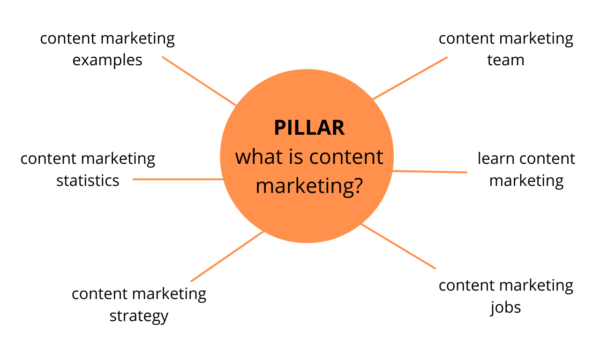
A topic cluster is a set of related articles that are all connected to one central, comprehensive pillar page.
Here’s how the two pieces work together:
- The pillar page covers the main subject broadly, at a high level. It touches on every major subtopic without going too deep into any single one.
- Each cluster article takes one of those subtopics and explores it in much greater detail — with specific examples, steps, and explanations that the pillar page doesn’t have room for.
- The links flow both ways. Every cluster article links back to the pillar page, and the pillar page links out to every article in its cluster. This bidirectional linking is what actually creates the “cluster” — without it, you just have a pile of loosely related posts.
Example structure:
Pillar Topic: Content Marketing for Bloggers
Cluster Topics:
- What is a Topic Cluster?
- Keyword Clustering
- Content Calendar
- Content Audit
- Search Intent
- Cornerstone Content
- Internal Linking
- Content Refresh Strategy
Individually, these are useful articles. Linked together under one pillar, they become a complete resource — the kind of resource that keeps a reader on your site for ten pages instead of one, and the kind of resource search engines associate with genuine expertise.
Why Topic Clusters Matter for SEO
Search engines increasingly reward sites that demonstrate depth, not just individual pages that happen to match a query well. Google’s ranking systems are built to evaluate whether a website — not just a page — reliably covers a subject in a way that satisfies searchers.
A well-built topic cluster helps on several fronts at once:
- Builds topical authority — publishing many connected, high-quality articles on one subject signals genuine expertise rather than a one-off attempt to rank.
- Improves internal linking — link equity (the ranking value passed between pages) flows more efficiently through a deliberately structured site than through disconnected posts.
- Increases page views — readers who land on one cluster article are naturally guided to related articles and the pillar page, instead of leaving after one visit.
- Helps search engines crawl content — a clear internal link structure makes it easier for crawlers to discover and index every page in the cluster.
- Keeps visitors engaged longer — more relevant internal links mean more time on site, which is itself a positive engagement signal.
- Reduces orphan pages — pages with no internal links pointing to them are hard for both users and search engines to find; clusters largely eliminate this problem.
- Makes content easier to discover — both for human readers browsing your site and for search engines mapping its structure.
The effect compounds over time: the stronger a cluster becomes, the easier it is for new articles added to that cluster to gain visibility, because they inherit authority from the existing pillar and its linked pages.
How a Topic Cluster Works
A helpful way to visualize this: think of your website as a library.
- The pillar page is the main book on the shelf — the one that gives a full overview of the subject.
- The cluster articles are individual chapters — each one goes deep on a single piece of the larger topic, while still pointing readers back to the complete guide.
Example:
Pillar Page: Content Marketing for Bloggers
Cluster Articles:
- Topic Cluster Strategy
- Blog Keyword Research
- Search Intent
- Blog Content Calendar
- Internal Linking
- Content Audit
- Cornerstone Content
Because every “chapter” links back to the “book,” readers can move fluidly between a broad overview and specific, actionable detail — without hitting a dead end or losing context.
Pillar Page vs. Cluster Content
Beginners often mix these two up, so here’s a direct comparison:
| Pillar Page | Cluster Article |
| Covers the whole topic | Covers one specific subtopic |
| Usually 3,000–6,000 words | Usually 1,200–2,500 words |
| Targets broad, high-volume keywords | Targets long-tail, specific keywords |
| Links out to all cluster articles | Links back to the pillar page |
| Acts as the main resource / entry point | Provides detailed, focused explanations |
Neither one works well without the other. A pillar page with no supporting articles is too shallow to compete for broad terms. Cluster articles with no pillar page lack the context and internal-linking structure that make them rank efficiently. They’re designed to function as a system.
Benefits of a Topic Cluster Strategy for Blogs
Builds Topical Authority
Publishing dozens of articles that are all clearly related — and clearly linked — shows search engines a pattern of consistent expertise, not a single lucky ranking. Over time, this improves your odds of ranking well for new content on the same subject, even before it earns backlinks of its own.
Improves Internal Linking
In a cluster, every article supports at least one other. Readers move naturally from post to post, and link authority (sometimes called “link equity”) gets distributed across the whole group rather than concentrating in one page and starving the rest.
Increases Organic Traffic
Rather than betting everything on one high-volume keyword, a cluster lets you rank for hundreds of related long-tail searches simultaneously. Each cluster article becomes its own entry point into your site. In practice, the combined traffic from many smaller-volume keywords often exceeds what a single big-keyword article could deliver on its own — and it’s more resilient to ranking fluctuations, since you’re not dependent on one page holding one position.
Improves User Experience
Visitors find complete answers faster because related information is one click away instead of a fresh search away. This tends to increase time-on-site and pages-per-session, both of which correlate with better engagement and, indirectly, better rankings.
Makes Future Content Easier
Once the structure exists, deciding where a new article belongs becomes almost mechanical. You’re not guessing at your content strategy from scratch each time — you’re filling a known gap in an existing map.
How to Choose Your Pillar Topic
Start broad — broader than feels natural if you’re used to writing single, narrowly-targeted posts.
Your pillar topic should be able to answer a large, general question that has room underneath it for many specific subtopics. Good examples include:
- Content Marketing
- Email Marketing
- Local SEO
- Affiliate Marketing
- WordPress SEO
- Pinterest Marketing
Avoid topics that are too narrow to support a cluster. A pillar topic needs enough surface area to justify eight or more supporting articles.
For example, instead of:
- Internal Link Plugin (too narrow — there’s maybe one article’s worth of content here)
Choose:
- Internal Linking (broad enough to support articles on strategy, tools, plugins, anchor text, common mistakes, and more)
A good test: if you can only think of two or three subtopics before running out of ideas, the pillar topic is probably too narrow.
Find Related Cluster Topics
Once you have a pillar topic, brainstorm the specific questions and problems it should answer. Useful prompts include:
- What questions do beginners ask about this topic?
- What problems do readers commonly run into?
- What are the individual steps in the overall process?
- Which tools do people typically use?
- Which mistakes come up again and again?
For a content marketing blog, a reasonable set of cluster topics might include:
- Topic clusters
- Content calendar
- Keyword clustering
- Blog categories
- Content optimization
- Blog audit
- Search intent
- Evergreen content
- Content pruning
- Cornerstone content
- Internal linking
- Content gap analysis
Each article should solve exactly one problem. If you find a topic that seems to answer two different questions, that’s usually a sign it should be split into two separate cluster articles.
Perform Keyword Research
With your cluster topics mapped out, find a target keyword for each individual article. Focus on:
- Long-tail keywords — longer, more specific phrases that are easier to rank for and often convert better because they match precise intent.
- Question keywords — phrases people type as actual questions (“how do I…”, “what is…”).
- Low-competition keywords — terms where existing top-ranking pages are weaker or less authoritative, giving newer content a realistic shot.
- Related searches and “People Also Ask” questions — these reveal exactly what searchers want to know next, and often make excellent subheadings or entirely new cluster articles.
Example keywords for this exact topic:
- topic cluster strategy for blogs
- how to build topic clusters
- topic cluster examples
- pillar page vs topic cluster
- blog topic cluster template
Choose keywords that genuinely match what a reader is trying to accomplish. Forcing a keyword into content where it doesn’t naturally fit tends to hurt both readability and rankings — search engines are increasingly good at detecting unnatural keyword insertion, and readers notice it too.
Create a Logical Content Structure
Your site should reflect a clear hierarchy, not a flat list of unrelated posts. For example:
Content Marketing (Pillar)
├─ Topic Clusters
├─ Keyword Clustering
├─ Search Intent
├─ Content Calendar
├─ Cornerstone Content
└─ Internal Linking
Every article should fit naturally under its pillar. If a post doesn’t clearly belong to any existing cluster, that’s a sign either the post needs a home (a new or adjusted pillar) or it doesn’t belong on the site in its current form. Avoid scattering unrelated posts inside an otherwise focused cluster — it dilutes the topical signal you’re trying to build.
Write High-Quality Cluster Articles
Every cluster article should fully answer one specific question — no more, no less. A strong cluster article typically includes:
- A clear introduction that states what the reader will learn
- Thorough explanations written in plain language
- Practical, concrete examples rather than abstract advice
- Actionable steps the reader can actually apply
- FAQs that address related, smaller questions
Resist the urge to cover every related subtopic inside one article. If you find yourself explaining a concept that already has (or deserves) its own cluster article, link to it instead of rewriting it. Covering the same ground in multiple places creates keyword cannibalization — where two pages on your own site compete against each other in search results, which typically weakens both instead of helping either.
Build Strong Internal Links
Internal linking is what actually turns a group of articles into a cluster — without it, you just have similar content sitting in isolation. Best practices include:
- Link every cluster article back to the pillar page.
- Link the pillar page out to all of its cluster articles.
- Connect related cluster articles to each other where it makes sense naturally (not forced).
- Use descriptive anchor text — link text that tells both readers and search engines what the destination page is about (e.g., “learn more about keyword clustering” rather than “click here”).
- Avoid stuffing links into every paragraph; a handful of well-placed, relevant links is more effective than a link on every sentence.
Good internal linking does double duty: it improves navigation for real readers, and it clarifies topical relationships for search engines crawling your site.
Common Topic Cluster Mistakes
Even well-intentioned bloggers run into predictable problems when building clusters. Watch for these:
Writing Duplicate Content
Every article needs its own distinct purpose and angle. If two articles answer essentially the same question, merge them or sharpen the distinction between them.
Targeting the Same Keyword Across Multiple Pages
Each page should have its own focus keyword. When two pages compete for the same keyword, you’re not doubling your chances of ranking — you’re splitting your own authority and often weakening both pages’ positions.
Ignoring Internal Links
Without internal links tying everything together, a “cluster” is just a set of unrelated pages that happen to share a topic. Readers lose the thread, and search engines lose the structural signal that would otherwise boost the whole group.
Publishing Without a Plan
Publishing articles reactively, without mapping the cluster first, tends to produce gaps, overlaps, and inconsistent internal linking. Map the full cluster — pillar plus all planned subtopics — before writing the first article.
Creating Too Many Categories
Categories should stay broad and few in number; they’re meant to represent pillars, not individual subtopics. Use tags, not new categories, for finer-grained organization. A site with dozens of near-empty categories signals a disorganized structure rather than deep coverage.
Example of a Topic Cluster Strategy
Imagine a marketing blog building out its content marketing pillar.
Pillar Page: Content Marketing for Bloggers
Cluster Articles:
- What is a Topic Cluster?
- Keyword Clustering Explained
- How to Create a Content Calendar
- Blog Content Audit Guide
- Search Intent Explained
- Cornerstone Content Guide
- Evergreen Content Strategy
- Internal Linking Best Practices
- Content Gap Analysis
- Content Refresh Checklist
Every one of these ten articles supports the same central topic, and every one links back to the pillar page. Together, they form a genuine knowledge hub — not just ten posts that happen to be filed under the same category.
How Many Cluster Articles Do You Need?
There’s no fixed number that applies to every site. A practical starting point:
- One pillar page
- Eight to fifteen supporting articles
From there, expand gradually as you identify new subtopics, gaps, or reader questions. Large, established authority sites often end up with dozens of cluster articles under a single pillar topic over time — but that scale is the result of years of consistent expansion, not a starting requirement.
Quality matters more than quantity. Ten genuinely useful, well-linked articles will outperform thirty thin, redundant ones every time.
How Long Does It Take to See Results?
Topic clusters are a long-term SEO investment, not a quick win. Most sites begin noticing measurable improvement in a few areas first:
- Better crawling and indexing of pages across the cluster
- More pages getting indexed overall
- Stronger internal link signals reaching every article
- Gradually improving topical authority for the pillar subject
How quickly (and how much) you see results depends on several factors:
- Content quality — thin or generic articles won’t build authority no matter how well-linked they are
- Competition — a crowded niche takes longer to break into
- Backlinks — external links pointing to your cluster still matter alongside internal structure
- Website authority — an established site with existing trust will typically see results faster than a brand-new one
- Publishing consistency — a cluster built out steadily over months tends to perform better than one published all at once and then abandoned
In short: expect a matter of months, not days, and treat consistency as part of the strategy rather than an afterthought.
Best Practices for Building Topic Clusters
- Start with keyword research before writing anything.
- Build the pillar page first, so every cluster article has a home from day one.
- Publish supporting articles on a consistent schedule rather than in one burst.
- Use descriptive, natural internal links throughout.
- Refresh older content regularly instead of letting it go stale.
- Monitor rankings and traffic to see which articles are working and which need revision.
- Expand the cluster over time as new subtopics and reader questions emerge.
- Keep every article factually current and up to date.
- Cover each subtopic thoroughly rather than superficially.
- Focus on genuine reader intent over keyword-stuffing.
These habits, applied consistently, are what turn a topic cluster from a one-time project into a sustainable, compounding SEO strategy.
Final Thoughts
A topic cluster is more than an internal linking tactic — it’s a way of organizing your knowledge into a structure that benefits readers and search engines at the same time. Instead of publishing scattered, disconnected articles, you build content that deliberately strengthens everything around it.
Every new article you add should reinforce the overall cluster while still answering one specific question completely. Over time, this approach builds topical authority, supports stronger and more resilient rankings, and gives your audience an experience that keeps them reading instead of bouncing after one page.
If you’re serious about growing a blog through organic search, building a topic cluster strategy is one of the most reliable long-term investments you can make.
Frequently Asked Questions
What is a topic cluster in SEO?
A topic cluster is a group of related articles connected to one comprehensive pillar page. It helps search engines understand your site’s expertise on a subject and improves internal linking across related content.
What is the difference between a pillar page and a topic cluster?
A pillar page covers a broad topic at a high level, while cluster articles each explain one specific subtopic in much greater detail. Together, they form a structured, interconnected content hub.
How many articles should a topic cluster have?
There’s no fixed number, but starting with 8–15 supporting articles around one pillar page is a practical, sustainable approach for most blogs.
Do topic clusters improve SEO?
Yes. Topic clusters improve topical authority, strengthen internal linking, enhance user experience, and increase the number of related keywords a site can realistically rank for.
Can small blogs use topic clusters?
Absolutely. Even a brand-new blog benefits from organizing content around a small number of clear subjects instead of publishing unrelated posts with no shared structure.
How often should I update a topic cluster?
Review each cluster every few months. Refresh outdated information, tighten up internal links, and add new supporting articles as the topic — and your understanding of it — continues to grow.