
You spent hours writing a blog post.
You chose a keyword. You optimized the title. You structured everything carefully. Then you published — and nothing happened.
No traffic. No rankings. Just silence.
Sound familiar? There is a good chance search intent is the problem — and it is the one SEO mistake most bloggers never think to check.
This guide explains exactly what search intent is, why it matters more than most people realize, and how to get it right before you write a single word.
What Is Search Intent?
Search intent is the reason behind a search query.
When someone types something into Google, they are not just entering words — they have a specific goal in mind. They want to learn something, find a particular website, compare their options, or buy something.
Google’s entire job is to figure out that goal and deliver the most relevant result as fast as possible.
This is why search intent matters so much for bloggers. Google does not just match keywords anymore. It tries to match the purpose behind the keyword. If your content does not match that purpose — even if it contains the right keywords — Google will rank other pages above yours.
Getting the keyword right is step one. Matching the intent behind it is step two. Most bloggers only do step one.
For a full picture of how search intent fits into your overall SEO strategy, read our complete SEO guide for bloggers.
Why Search Intent Ruins Rankings
Here is a real-world example that makes this concrete.
Imagine you write a detailed, 3,000-word guide on “best email marketing software.” You cover features, pricing, integrations, and use cases. You pour genuine expertise into it.
Now look at the top five results for that keyword in Google. They are all comparison posts — “10 best email marketing tools ranked and reviewed.” Not educational guides. Not deep dives into email strategy. Comparison lists.
Google has determined that people searching “best email marketing software” want to compare options before making a decision. They want a ranked list with pros, cons, and recommendations. Not a comprehensive educational guide.
Your beautifully written guide does not match that intent. So Google ranks it lower — regardless of how good it actually is.
This is the core of how search intent ruins rankings. It is not about quality. It is about match.
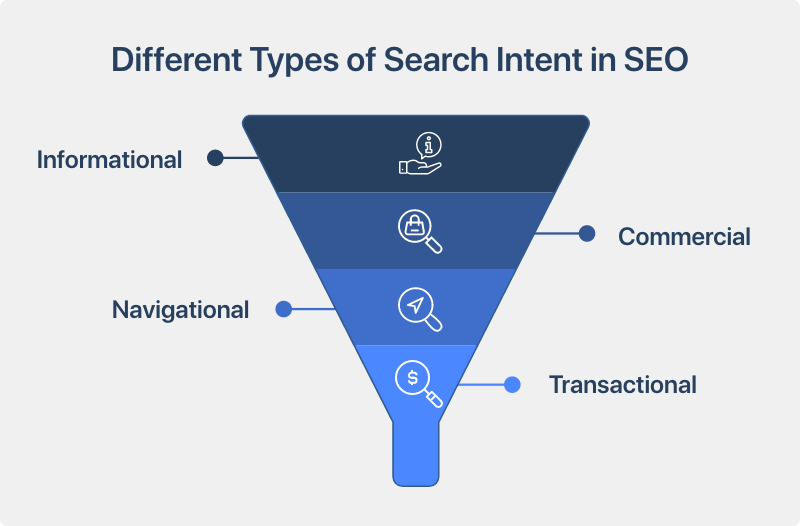
The Four Types of Search Intent
Every search query falls into one of four categories. Understanding them is what allows you to create content that actually ranks.
-
Informational Intent
The searcher wants to learn something.
They are in research mode, are not ready to buy, not looking for a specific site. They want an answer, an explanation, or a guide.
Examples:
- “how does SEO work”
- “what is insulin resistance”
- “why is my blog not getting traffic”
- “how to hard boil an egg”
Best content format: Educational articles, how-to guides, explainers, tutorials, pillar pages
Informational searches make up the largest share of all Google searches. Most blog content targets this intent — and when done correctly, it builds enormous long-term traffic.
-
Navigational Intent
The searcher is trying to reach a specific website or page.
The navigational intent already know where they want to go. They are just using Google as a shortcut to get there faster.
Examples:
- “YouTube login”
- “Ahrefs keyword explorer”
- “Marketing Strategy Insider blog”
Best content format: This intent is not a content opportunity for most bloggers. People are looking for a specific destination, not new information.
Unless someone is searching specifically for your brand, navigational searches are not worth targeting.
-
Commercial Investigation Intent
The searcher is researching before making a decision.
They know they want something, but they have not decided yet. They are comparing options, reading reviews, and weighing up choices. This intent sits between learning and buying.
Examples:
- “best keyword research tools for bloggers”
- “Ahrefs vs Semrush comparison”
- “WordPress vs Squarespace for blogging”
- “myo-inositol vs metformin for PCOS”
Best content format: Comparison posts, product roundups, reviews, “best of” lists, versus articles
Commercial investigation intent is extremely valuable for bloggers who monetize through affiliate marketing. These searchers are close to a decision and respond well to honest recommendations.
-
Transactional Intent
The searcher is ready to take action right now.
They want to buy, sign up, download, or register. The decision is largely made. They just need the right page in front of them.
Examples:
- “buy WordPress hosting”
- “sign up for Mailchimp”
- “download free SEO checklist”
- “book fitness coaching session”
Best content format: Sales pages, landing pages, product pages, download pages
Transactional intent content is less common in typical blogging but becomes important when you sell products, services, or digital downloads directly.
How Google Figures Out Intent
Google does not guess at intent. It measures it — through analyzing patterns across billions of searches.
When millions of people search a particular keyword, Google observes what they do next. Which results do they click? How long do they stay on those pages? Do they click back and try another result, or do they seem satisfied?
Over time, Google builds a strong statistical picture of what searchers want for every keyword. The pages ranking at the top of results are essentially Google’s answer to the question: “what content best matches the intent behind this search?”
This is why studying the top results before writing is not optional. It is the most reliable method you have for understanding exactly what Google believes searchers want. The current top-ranking pages are your blueprint.
How to Identify Search Intent Before You Write
You do not need a special tool. You need Google and five minutes.
Step 1: Search your target keyword
Open Google and type in the keyword you plan to target. Use a private or incognito browser window to avoid personalized results.
Step 2: Study the top five results
Look at what types of pages are ranking. Ask yourself:
- Are these blog posts or product pages?
- Are they listicles, how-to guides, or opinion pieces?
- Are they short and direct or long and comprehensive?
- What angle do they take on the topic?
Step 3: Look at the formats and structures
The format tells you what Google rewards for this keyword. Common formats include:
- Step-by-step guides — “how to” keywords
- Listicles — “best” and “top” keywords
- Definition posts — “what is” keywords
- Comparison articles — “vs” and “best X for Y” keywords
- Single-answer posts — simple factual questions
Step 4: Read the titles and headings
The headings in top-ranking posts reveal what sub-questions searchers want answered within the topic. These become your own subheadings.
Step 5: Check the People Also Ask box
The questions in the People Also Ask box show closely related angles Google associates with your keyword. These are often excellent additions to your post — or even separate cluster article ideas.
The Most Common Search Intent Mistakes Bloggers Make
Even experienced bloggers make these errors regularly.
Writing an essay when a list is what ranks
If every top result for your target keyword is a “10 best” roundup, writing a 3,000-word opinion piece misses the intent — regardless of how insightful it is.
Match the format that Google is already rewarding for that keyword.
Targeting informational keywords with sales content
If someone searches “what is email marketing,” they want to learn. Not to be sold to. A page that opens with a pricing plan or a sign-up button immediately signals the wrong intent — and Google penalizes the mismatch.
Keep educational content educational. Save your selling for keywords where commercial or transactional intent is clearly present.
Assuming all similar keywords have the same intent
This catches many bloggers off guard.
“Email marketing tips” and “best email marketing tools” sound similar. But one is informational (tips = teach me), and the other is commercial investigation (best tools = help me choose).
Never assume two keywords share the same intent just because they cover the same topic. Check each one individually.
Ignoring intent when updating old posts
Many bloggers update old posts by adding new information without considering whether the intent match has shifted.
If Google’s understanding of what searchers want for a keyword has changed since you first published, your content may now be mismatched — even if the information is accurate and current.
How to Fix an Intent Mismatch on an Existing Post
If you have posts that are ranking on page two or three but not climbing, an intent mismatch is often the reason. Here is how to fix it.
- Search your target keyword and study what the current top results look like
- Compare your post’s format and angle to what is ranking
- Identify the gap — is your content the wrong format, the wrong depth, or answering the wrong question?
- Restructure or rewrite the post to match the dominant intent format
- Update the title and meta description to reflect the correct intent more clearly
- Add or remove sections based on what top results include and exclude
This process alone has turned stagnant page-two posts into page-one rankings for many bloggers — without changing the core keyword or starting from scratch.
Intent and Content Format — A Quick Reference
Here is a practical table to guide your content decisions:
| Keyword Pattern | Likely Intent | Best Content Format |
| “how to [do something]” | Informational | Step-by-step tutorial |
| “what is [topic]” | Informational | Definition + explainer |
| “why does [thing] happen” | Informational | Educational article |
| “best [product/tool] for [use]” | Commercial | Ranked listicle or review |
| “[X] vs [Y]” | Commercial | Comparison post |
| “[brand name] review” | Commercial | Single product review |
| “buy [product]” | Transactional | Product or sales page |
| “download [resource]” | Transactional | Landing page with download |
| “[brand name] login” | Navigational | Not a blogging opportunity |
Print this out and refer to it before writing any new post.
Search Intent and Google’s E-E-A-T
Search intent does not exist in isolation. It connects directly to Google’s E-E-A-T framework — Experience, Expertise, Authoritativeness, and Trustworthiness.
When you match search intent correctly, you immediately demonstrate two things to Google:
First, that you understand what the searcher actually needs. Second, that your content is organized around serving that need rather than just stuffing keywords into a page.
Both signals contribute positively to how Google evaluates your content’s quality and trustworthiness. Intent matching is therefore not just a formatting decision — it is an authority signal.
Search Intent in Your Content Planning Workflow
Once you understand intent, it should shape your content decisions from the start — not as an afterthought.
Here is where it fits into a practical workflow:
- Choose a keyword from your research list
- Search it and identify the dominant intent type
- Choose your content format based on what Google is already rewarding
- Outline your post using the headings and sub-questions you found in top results and People Also Ask
- Write your content with the intent clearly in mind throughout
- Review before publishing — does your title, introduction, and overall structure immediately signal the correct intent?
This workflow eliminates one of the most common reasons new blog posts fail to gain traction — and it takes less than ten extra minutes per post once it becomes habit.
Final Thoughts
Search intent is not a complicated concept once you see it clearly.
Every person who types something into Google has a specific goal. Google’s job is to find the content that best matches that goal. Your job as a blogger is to understand that goal before you write — and then create content that serves it better than anything else on the page.
Get the keyword right and the intent wrong, and your content will always underperform. Get both right, and you give your posts the best possible chance of ranking, staying ranked, and bringing in consistent traffic month after month.
Before you write your next post, spend five minutes studying what Google is already rewarding for your target keyword. Match that format. Answer that intent. Then focus on making your version the most genuinely useful result on the page.
That is what search intent optimization actually looks like in practice — and it is one of the simplest shifts that produces real ranking results.
For the full roadmap of growing your blog with search traffic, head back to our complete SEO guide for bloggers.
FAQs
Q1. What is search intent in simple terms?
Search intent is the goal behind a search query — what the person actually wants to find when they type something into Google. It could be learning something, finding a specific site, comparing options, or making a purchase.
Q2. Why does search intent matter for blog rankings?
Google ranks content based on how well it matches what searchers want — not just whether it contains the right keywords. If your content answers the wrong question or uses the wrong format for a keyword, Google ranks other pages above yours even if your writing is better.
Q3. How do I find the search intent for a keyword?
Search the keyword in Google and study the top five results. Look at the content format (listicle, guide, review), the angle taken, and the structure used. What ranks tells you what Google believes searchers want for that keyword.
Q4. What are the four types of search intent?
The four types are informational (wanting to learn), navigational (looking for a specific site), commercial investigation (researching before deciding), and transactional (ready to act or buy). Each type requires a different content format and approach.
Q5. Can I rank for a keyword if my content format does not match the intent?
It is very difficult. Google strongly favors content that matches the dominant intent for a keyword. Even excellent content in the wrong format typically struggles to rank above pages that correctly match the intent.
Q6. How do I fix a post that has an intent mismatch?
Search your target keyword, compare your post’s format to what is currently ranking, and restructure or rewrite your content to match the dominant intent format. Update your title and headings to reflect the correct angle. This alone can move a stagnant page-two post onto page one.