
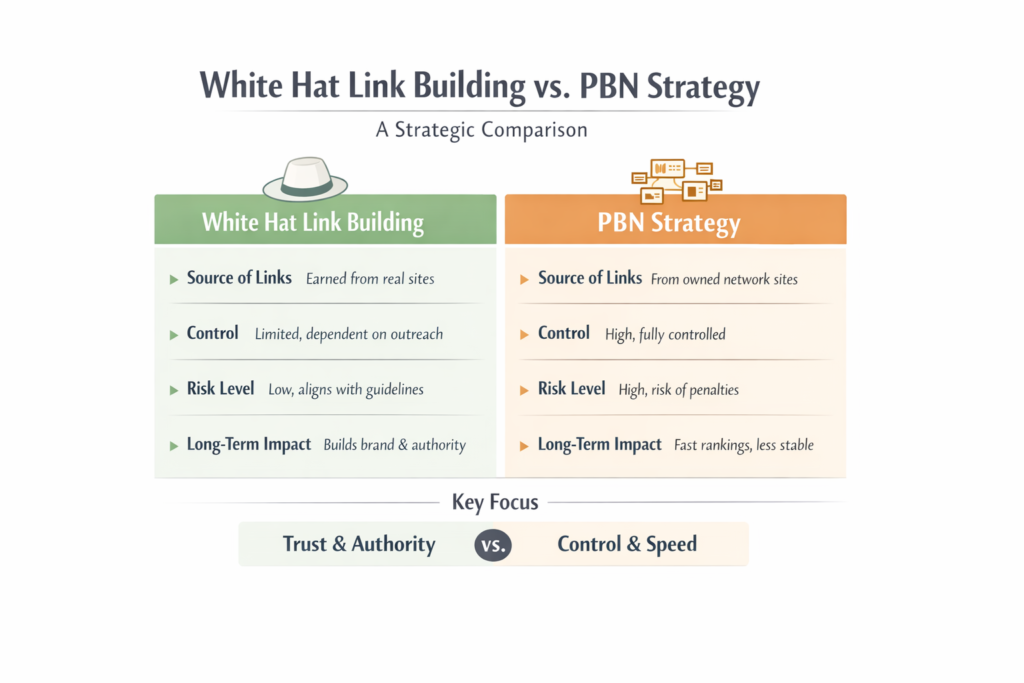
When I first started studying advanced SEO, I thought the debate between white hat links and PBN strategies was simple.
One was “safe.”
The other was “risky.”
But the more I worked with real businesses, real budgets, and real expectations, the more I realized the conversation isn’t about morality.
It is about strategy.
Alignment.
And about what kind of business you are building.
Over the years, I’ve analyzed campaigns powered by white hat link building strategies and others boosted by a PBN website network. I’ve seen explosive growth. Devastating drops. I’ve seen founders celebrate. I’ve seen them panic.
So this is not a theoretical comparison.
This is a strategic one.
What We’re Actually Comparing
Before going deeper, I want to clarify something.
When people say “PBN,” they usually mean:
- A network of sites owned or controlled by the same entity.
- Built primarily to pass link equity.
- Designed to influence rankings directly.
When people say “white hat link building,” they usually mean:
- Links earned through outreach, digital PR, or content.
- Real editorial placements.
- Independent websites linking by choice.
The difference isn’t just technical.
It’s structural.
One model centralizes control.
The other distributes authority.
That distinction changes everything.
Why PBNs Attract Smart Marketers
Let me be honest.
The appeal of a PBN website is control.
- You control anchor text.
- You control placement.
- You control link velocity.
- You control timing.
There’s no waiting for journalists to respond.
No hoping someone links naturally.
No chasing editors.
If you need rankings quickly, the PBN route can feel efficient.
I’ve seen affiliate sites move from page 4 to page 1 after strategic PBN placements. In highly competitive niches, it can look like a superpower.
But control has a cost.
The Real Cost of PBN-Based Growth
When someone relies on PBN structures, they’re making a few silent assumptions:
- Search engines won’t detect the footprint.
- Links won’t be devalued algorithmically.
- Rankings gained will remain stable.
- The maintenance overhead is worth it.
But here’s what I’ve observed.
The more dependent a business becomes on PBN signals, the more fragile its growth model becomes.
If rankings dip, the reaction is usually:
Add more links.
Increase anchor density.
Strengthen internal network signals.
Dependency increases.
Over time, growth becomes artificial oxygen.
Remove it, and performance weakens.
That fragility matters if you are building a brand, not just chasing rankings.
What White Hat Links Actually Represent
When I work on white hat link building strategies, I look at them differently.
I don’t see them as “safe links.”
I see them as:
- Reputation signals.
- Brand validation.
- Authority borrowed from independent ecosystems.
When a real publication links to your content, it exists outside your control. That independence is precisely what gives it power.
A white hat link building agency isn’t selling control. It’s building relationships.
And relationships compound.
A journalist who links once may link again.
A brand partnership may expand.
A piece of data-driven content may attract passive links for years.
This is not instant gratification.
But it builds structural authority.
Speed vs Sustainability
In every strategy conversation, I eventually reduce the debate to one core tension:
Speed versus sustainability.
PBN-based growth can be faster.
White hat links are slower but stronger long-term.
If a founder tells me:
“I want to dominate quickly and I’m comfortable with volatility,”
The recommendation is different from someone who says:
“I want to build a brand that survives algorithm updates and investor scrutiny.”
Because here’s the reality:
Investors, partners, and serious brands care about risk exposure.
And heavy reliance on PBN structures increases exposure.
Risk Is Not Binary
One of the biggest misconceptions in SEO is that tactics are either safe or dangerous.
That’s too simplistic.
Risk exists on a spectrum.
With a PBN website model, risk depends on:
- Network footprint.
- Hosting diversity.
- Link patterns.
- Anchor manipulation.
- Scale.
With white hat links, risk is lower but still present if:
- Outreach is spammy.
- Anchor text is over-optimized.
- Placements are paid and undisclosed.
But structurally, white hat link building strategies align more closely with search engine guidelines.
That alignment reduces long-term uncertainty.
And uncertainty is expensive.
Brand Equity vs Ranking Equity
This is where I think many marketers miss the deeper difference.
PBN links primarily influence ranking equity.
White hat links influence both ranking and brand equity.
Let me explain.
If your site ranks because of a private network and the network disappears, your visibility drops.
If your site ranks because respected publications reference you, even if rankings fluctuate, your brand presence remains.
Brand equity is resilient.
Ranking equity alone is not.
When I design strategies for service-based businesses, I focus on signals that build brand equity alongside search performance.
Because rankings without trust are unstable.
The Maintenance Equation
Building a PBN is not a one-time investment.
It requires:
- Domain acquisition.
- Hosting management.
- Content creation.
- Footprint monitoring.
- Ongoing link balancing.
That’s infrastructure.
Some operators manage this extremely well. But it’s a separate operational layer.
When I compare that to white hat link building strategies, the effort goes into:
- Content assets.
- Research.
- Relationship outreach.
- Media positioning.
Both require effort.
But one builds independent assets.
The other maintains controlled ones.
That distinction matters when scaling.
Client Perspective: What Businesses Actually Want
When I consult with founders, very few say:
“I want a clever ranking hack.”
Most say:
- I want predictable growth.
- I want reduced volatility.
- I want long-term visibility.
- I want credibility in my space.
That changes the framework.
A white hat link building agency typically aligns better with businesses that think in years, not months.
A heavy PBN approach often aligns with operators who think in campaign cycles.
Neither is automatically wrong.
But they serve different mindsets.
Hybrid Models: The Gray Area
There is also a reality many won’t admit publicly.
Some businesses use hybrid models.
They invest in white hat links for brand authority while supplementing with controlled placements.
The intention is diversification.
But hybrid strategies require discipline.
If the controlled signals outweigh earned authority, dependency creeps in again.
Balance is harder than it sounds.
And without clear strategic guardrails, hybrid often turns into over-reliance.
How I Think About It Now
After years of analyzing campaigns, here’s how I personally evaluate the decision.
- What is the business horizon?
- What is the tolerance for volatility?
- Is investor scrutiny likely?
- Does brand trust matter beyond search?
- Is this an exit-focused project or a legacy brand?
If the answers point toward longevity, reputation, and scale, I lean strongly toward white hat link building strategies.
If the project is short-term, affiliate-driven, and aggressively competitive, the calculus changes.
But even then, I factor in maintenance and psychological dependency.
Because once rankings start responding to controlled signals, restraint becomes difficult.
The Strategic Difference in One Sentence
PBN builds influence through ownership.
White hat links build influence through recognition.
Ownership gives control.
Recognition gives legitimacy.
Control can be engineered.
Legitimacy must be earned.
And in my experience, legitimacy compounds more reliably.
Final Perspective
I don’t treat this debate as moral.
I treat it as structural.
If your strategy depends heavily on a PBN website ecosystem, you are responsible for maintaining that ecosystem indefinitely.
If your strategy focuses on white hat links, you are investing in distributed authority across the web.
One centralizes power.
One distributes it.
Centralized systems can move faster.
Distributed systems are harder to collapse.
For serious brands thinking beyond the next algorithm update, that difference is not small.
It is foundational.
And in my work with growth-focused businesses, foundational stability almost always wins over temporary acceleration.