
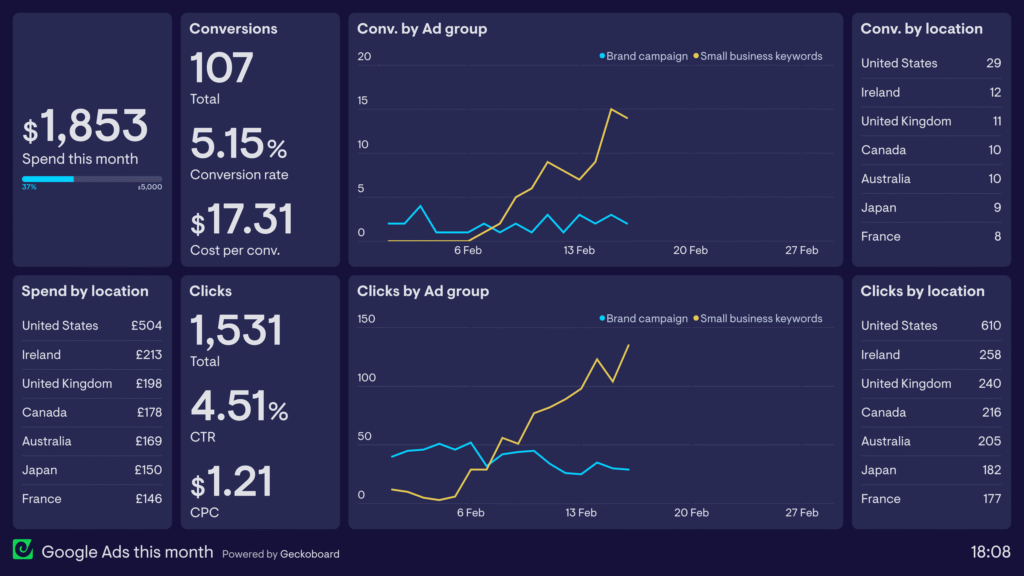
For years, digital advertisers operated under a simple belief: Google Ads runs on keywords. Choose the right keywords, match them correctly, write compelling ad copy, and performance would follow.
That model worked well in the era of manual optimization. But today, the system has evolved. While keywords still exist inside Google Ads accounts, they are no longer the central force driving performance. Machine learning, audience signals, automation, and search intent analysis now play a far greater role in determining which ads appear and when.
The platform once known as AdWords has transformed into a sophisticated, AI-driven advertising ecosystem. Understanding this shift is critical for marketers who want to remain competitive in modern Google search advertising.
This article explores:
- Why Google Ads no longer runs purely on keywords
- How automation and AI changed ad delivery
- The role of search intent
- The decline of rigid keyword control
- What this means for advertisers
- How to adapt campaigns for the new reality
The Evolution from AdWords to AI-Driven Advertising
When Google launched AdWords, the system was keyword-centric. Advertisers would:
- Select specific keywords
- Choose match types
- Set manual bids
- Control ad placement tightly
Performance was largely dependent on how precisely keywords were selected and matched to user queries.
However, over time, Google search advertising began integrating machine learning to improve relevance and efficiency. Today, ads by Google rely heavily on AI systems that interpret:
- User behavior
- Search history
- Contextual signals
- Device data
- Location
- Time of day
- Predicted intent
Keywords remain part of the interface, but they function more as directional signals rather than rigid triggers.
The Decline of Exact Keyword Dependence
Historically, advertisers relied on three main keyword match types:
- Exact match
- Phrase match
- Broad match
Exact match once meant strict query alignment. Today, even exact match allows for close variants, semantic similarities, and inferred intent.
Broad match, once considered risky, now performs differently because AI evaluates contextual signals and user behavior beyond the typed query.
This shift reflects a deeper transformation. Google Ads does not simply match keywords to queries anymore. It matches ads to users and their intent.
The Rise of Search Intent Over Keywords
Search intent has become the dominant factor in ad delivery.
Search intent refers to the underlying goal behind a query. For example:
- Informational intent
- Navigational intent
- Transactional intent
- Commercial investigation intent
Modern search intent analysis allows Google’s systems to predict what a user is trying to accomplish rather than relying solely on literal words.
Two users may type similar keywords but receive different ads because:
- One has prior purchase behavior
- One is browsing casually
- One has high buying signals
- One is comparing options
Google Ads interprets behavioral and contextual data to serve the most relevant ad at that moment.
In this environment, keyword lists alone cannot control targeting.
Machine Learning at the Core of Google Ads
Google Ads now operates on advanced machine learning models that continuously learn from user interactions.
Key automated features include:
- Smart bidding
- Responsive search ads
- Performance Max campaigns
- Audience targeting expansion
- Automated creative testing
Smart bidding strategies, such as Target CPA or Target ROAS, rely on historical data and predictive modeling. These systems evaluate thousands of signals in real time.
Unlike manual bidding, smart bidding does not depend solely on keywords. It optimizes based on predicted conversion likelihood.
This fundamentally changes how an AdWords campaign operates.
Performance Max and the Keyword Shift
One of the clearest examples of this evolution is Performance Max campaigns.
Performance Max does not require traditional keyword lists. Instead, advertisers provide:
- Creative assets
- Audience signals
- Conversion goals
Google’s AI determines where and when ads appear across:
- Search
- Display
- YouTube
- Gmail
- Discover
The system uses search intent analysis and behavioral modeling to match ads to users across channels.
This demonstrates that modern Google Ads operates on intent and signals, not just keywords.
Why Google Made This Shift
Several factors influenced the move away from keyword dependence.
-
Complexity of User Behavior
Users rarely follow linear buying journeys. They research, compare, revisit, and purchase across devices and sessions.
Keyword targeting alone cannot capture this complexity.
-
Explosion of Query Variations
Search queries have become longer and more conversational. Rigid keyword matching struggles to cover the endless variations.
AI models interpret semantic meaning rather than literal phrasing.
-
Privacy and Data Shifts
With increasing privacy regulations and reduced third-party tracking, platforms rely more on first-party data and contextual intent.
-
Automation Efficiency
Automation allows Google to optimize performance at scale, often outperforming manual management in data-heavy environments.
What This Means for Advertisers
The shift does not mean keywords are irrelevant. Instead, their role has changed.
Keywords now function as:
- Intent signals
- Directional indicators
- Input variables within a larger AI system
Advertisers who cling to rigid keyword control may struggle to scale. Success now depends on broader strategic alignment.
Rethinking Campaign Structure
Modern campaign structure requires adaptation.
Instead of building tightly segmented ad groups based on small keyword clusters, advertisers should focus on:
- Thematic grouping
- Audience signals
- Clear conversion goals
- High-quality creative assets
The emphasis shifts from micro-control to strategic input.
The Role of Creative Assets
As automation increases, creative quality becomes more important.
Responsive search ads combine multiple headlines and descriptions. AI tests combinations to determine which performs best.
Performance Max relies heavily on:
- Images
- Videos
- Text assets
- Audience signals
When keywords lose dominance, messaging clarity and value proposition become critical differentiators.
Data and Conversion Tracking Matter More Than Ever
Automation only works effectively when fed accurate data.
Strong campaigns require:
- Accurate conversion tracking
- Clear goal definitions
- Clean analytics integration
- Offline conversion imports when applicable
Without proper tracking, smart bidding systems cannot optimize effectively.
In this sense, campaign setup has become more technical and data-driven.
The New Skill Set for Advertisers
The evolution of Google search advertising demands new competencies.
Modern advertisers must understand:
- Search intent analysis
- Audience segmentation
- Conversion rate optimization
- Data interpretation
- Automation management
The focus moves from keyword manipulation to system guidance.
Are Keywords Completely Dead?
No. Keywords still exist within the platform. They remain useful for:
- Providing intent signals
- Excluding irrelevant traffic
- Structuring campaign themes
- Identifying search trends
However, they no longer operate as isolated levers of control.
Instead of thinking “Which keywords should trigger my ad?” advertisers should think “Which users with which intent should see my message?”
This subtle shift represents a major philosophical change.
Practical Strategies for the Modern Era
To succeed in this AI-driven advertising environment:
- Focus on conversion tracking accuracy
- Use smart bidding strategies appropriately
- Provide strong creative assets
- Allow algorithms sufficient data to learn
- Analyze search terms for intent insights rather than strict matching
- Structure campaigns around themes and goals
Advertisers should test automation thoughtfully rather than resisting it outright.
The Future of Google Ads
Google Ads will likely continue moving toward automation and intent-based targeting.
Future developments may include:
- Increased predictive modeling
- Greater reliance on first-party data
- More conversational ad formats
- Enhanced cross-platform integration
As AI continues to improve, the role of manual keyword management will likely decrease further.
Advertisers who adapt early will gain a competitive advantage.
Conclusion
Google Ads no longer runs purely on keywords. While keywords remain part of the system, they serve as signals within a much larger AI-driven framework.
Modern Google search advertising relies on:
- Search intent analysis
- Machine learning
- Audience signals
- Predictive bidding
- Automation
The transition from AdWords to AI-powered advertising represents a structural evolution.
Success now depends on guiding intelligent systems rather than controlling every keyword trigger.
Advertisers who embrace this shift will discover that performance can improve when strategy focuses on intent, data quality, and creative strength rather than rigid keyword lists.
The future of ads by Google is not keyword-centered. It is intent-driven, signal-based, and powered by machine learning. Understanding that reality is the first step toward sustainable advertising success.