
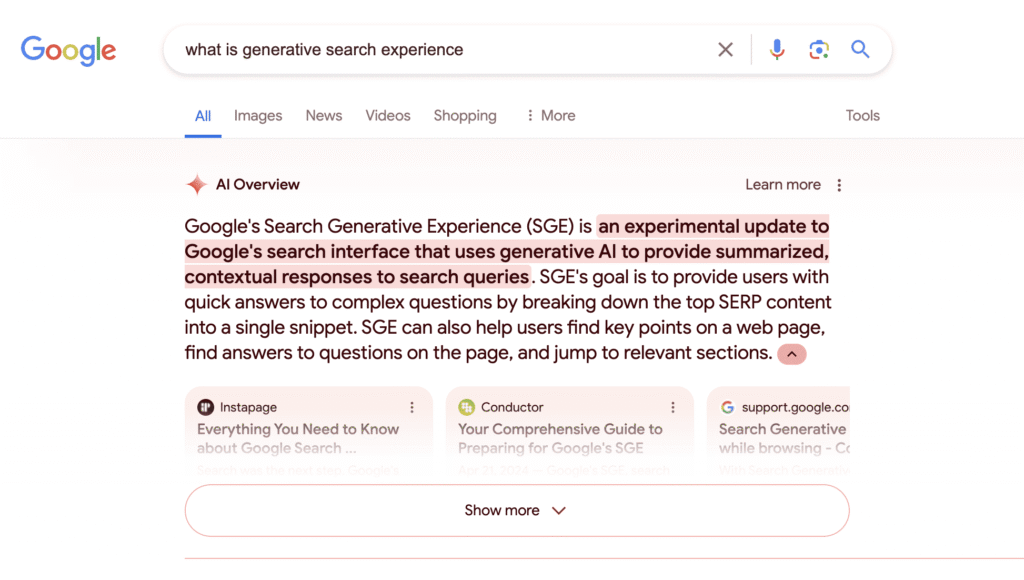
Search engine optimization has evolved far beyond keyword stuffing and backlink chasing. Today, success in search depends on how well you understand your audience, their needs, and how search engines interpret intent. With the introduction of Google’s SGE, the shift has become even more pronounced.
This new AI-powered search experience is redefining how content is discovered, ranked, and consumed. If you are still relying only on keywords, you may already be falling behind.
What Is Google’s SGE?
Google’s SGE is an AI-driven search feature that generates summarized answers directly on the search results page. Instead of showing only a list of links, it provides:
- Context-rich answers
- Synthesized information from multiple sources
- Follow-up suggestions
- Conversational search experience
This means users can get answers without clicking multiple websites, which significantly changes how traffic flows.
The Shift from Keywords to Intent
Traditional SEO focused heavily on keywords:
- Finding high-volume search terms
- Placing them strategically in content
- Optimizing density and repetition
But modern search engines prioritize understanding search intent, also known as User Intent.
User Intent Meaning
User intent refers to the purpose behind a search query. It answers the question:
- Why is the user searching this?
Understanding this is now more important than the exact words used.
Types of Search Intent
To succeed in SEO today, you must align your content with different types of search intent.
Informational Intent
- Users want to learn something
- Example: What is SEO
Navigational Intent
- Users want to find a specific website
- Example: Facebook login
Transactional Intent
- Users are ready to take action
- Example: Buy SEO tools
Commercial Investigation
- Users compare options before making a decision
- Example: Best SEO tools for beginners
These types of search intent guide how content should be structured and presented.
Why Keywords Alone No Longer Work
Search Engines Understand Context
Modern algorithms analyze:
- Meaning behind words
- Synonyms and related phrases
- Context of the query
This reduces the importance of exact keyword matching.
AI Generates Answers
With Google’s SGE:
- Users get direct answers
- Fewer clicks go to websites
- Only high-quality, relevant sources are referenced
Content Saturation
The internet is filled with keyword-optimized content. What stands out now is:
- Depth
- Clarity
- Relevance
Focus on Experience
Search engines evaluate:
- How helpful your content is
- Whether it solves the user’s problem
- How easy it is to read and navigate
The Role of Trust Signals in Modern SEO
Trust signals are indicators that show your content is credible and reliable.
Examples of Trust Signals
- Author expertise
- Accurate information
- Updated content
- Secure website
- Positive user engagement
These signals influence whether your content is selected by AI systems like Google’s SGE.
How Google’s SGE Changes Content Strategy
Content Must Answer Questions Clearly
- Provide direct and concise answers
- Use structured formatting
- Avoid unnecessary fluff
Depth Over Volume
Instead of writing many keyword-focused articles:
- Create comprehensive guides
- Cover topics in detail
- Address multiple related queries
Conversational Content Wins
SGE supports follow-up questions, so content should:
- Use natural language
- Anticipate user queries
- Provide clear explanations
Authority Matters More
Content from trusted sources is more likely to be featured.
Build authority through:
- Expertise
- Consistency
- Quality publishing
User Intent Marketing: The New SEO Approach
User intent marketing focuses on aligning content with what users actually need.
Key Principles
- Understand your audience deeply
- Map content to each stage of the journey
- Solve real problems
How to Apply User Intent Marketing
Research Intent
- Analyze search queries
- Study audience behavior
- Identify pain points
Create Intent-Based Content
- Match content type to intent
- Use clear headings
- Provide actionable insights
Optimize for Engagement
- Improve readability
- Use visuals where needed
- Encourage interaction
Content Optimization in the SGE Era
Use Topic Clusters
Instead of isolated articles:
- Build interconnected content
- Cover broad topics with subtopics
Focus on Semantic SEO
Include:
- Related terms
- Natural variations
- Contextual relevance
Structure Matters
Well-structured content performs better:
- Clear headings
- Bullet points where needed
- Short paragraphs
Answer First, Then Expand
Start with a direct answer, then provide details. This aligns with how Google’s SGE extracts information.
The Role of AI in Search
AI is transforming how search engines work:
- Understanding language better
- Predicting user needs
- Generating responses
This makes SEO less about gaming the system and more about genuinely helping users.
Common Mistakes to Avoid
- Overusing keywords unnaturally
- Ignoring user intent
- Writing shallow content
- Neglecting content updates
- Focusing only on rankings, not value
Future of SEO with Google’s SGE
The future of SEO will revolve around:
- User-centric content
- Trust and authority
- AI compatibility
- Real value delivery
Websites that adapt will continue to thrive, while outdated strategies will lose effectiveness.
Final Thoughts
SEO is no longer about inserting the right keywords in the right places. It is about understanding people, their needs, and delivering meaningful content.
With Google’s SGE reshaping search behavior, the focus has shifted to intent, trust, and quality. By embracing this change and prioritizing user intent marketing, you can stay ahead in the evolving digital landscape.